A high compositional benchmark score doesn't tell you what you think it does.
CLIP's high scores on compositional benchmarks largely reflect a familiarity asymmetry and
memorized seen (familiar) bindings, not generalization to unseen (novel) bindings.
We introduce BindSplit, a protocol that splits any benchmark into seen and unseen
(attribute, object) bindings, and find the benchmarks barely test unseen generalization.
We should report the splits separately — the aggregate benchmark score is hiding potential shortcuts and
a generalization gap.
Problem
A higher benchmark score doesn't tell you memorization or generalization.
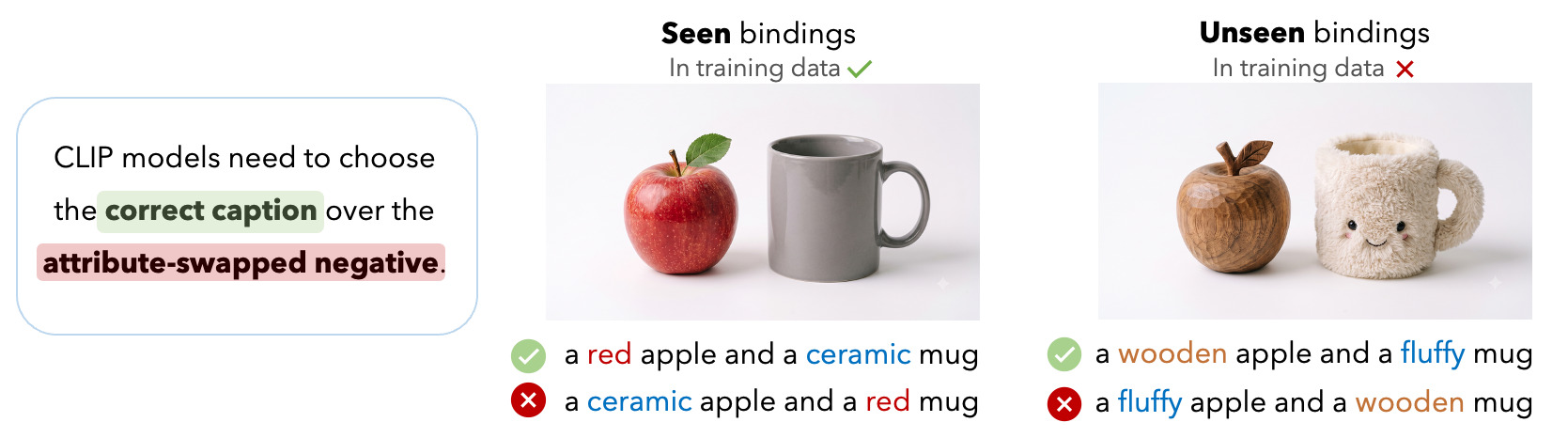
When CLIP picks "a red apple and a ceramic mug" over the attribute-swapped negative
"a ceramic apple and a red mug," is it generalizing to novel bindings or recognizing ones
it saw in training? The aggregate score can't tell you which.
Every new method reports a higher benchmark score than the last, but does a higher score reflect better
generalization to novel bindings or more memorization of familiar bindings?
The benchmarks don't separate them.
Protocol
BindSplit: Split the benchmark by what the model has seen.
BindSplit parses the (attribute, object) bindings in each caption, labels them
seen or unseen against
the training distribution (or a proxy like COCO for real benchmarks), and partitions the benchmark
accordingly into seen and unseen (bindings) evaluation splits. It requires no new data collection, and it works
on benchmarks you already use.
Findings
Two things become visible.
1CLIP degrades on unseen bindings
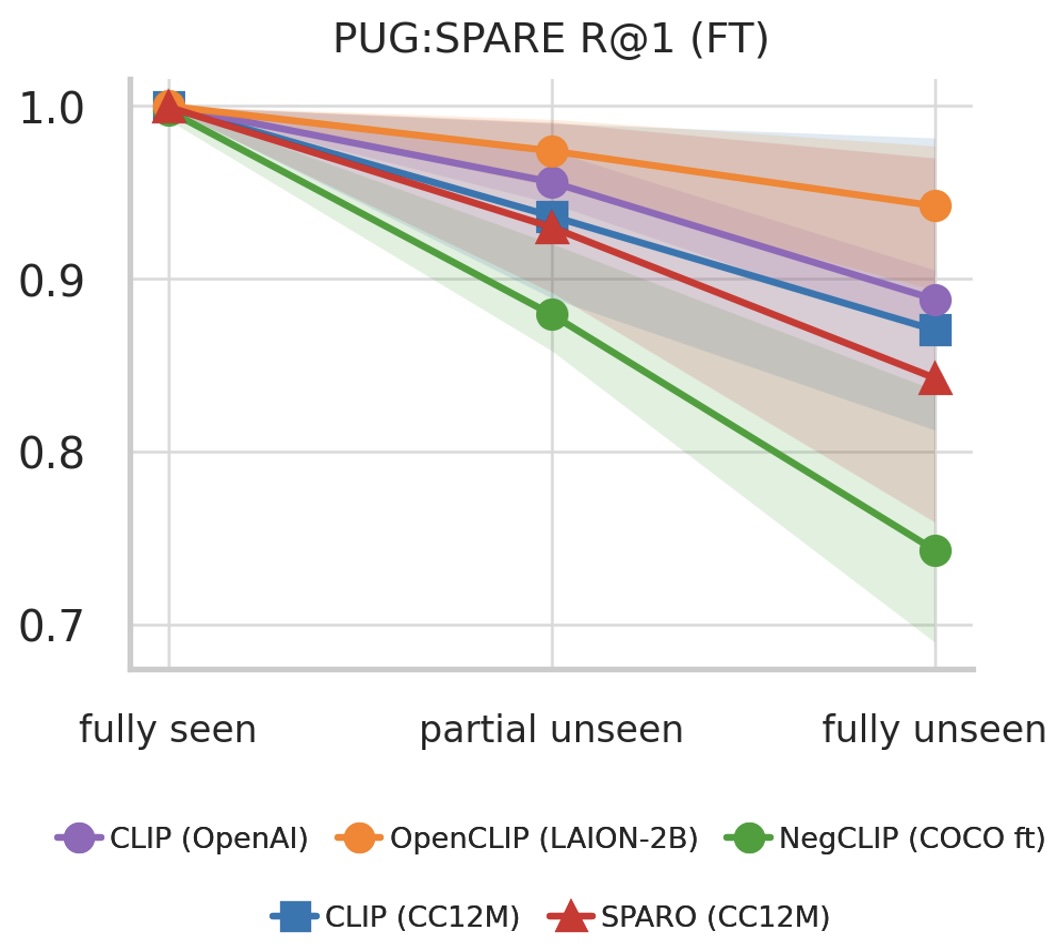
On synthetic data (PUG:SPARE), image-to-text retrieval drops monotonically as more of a
sample's bindings are unseen.
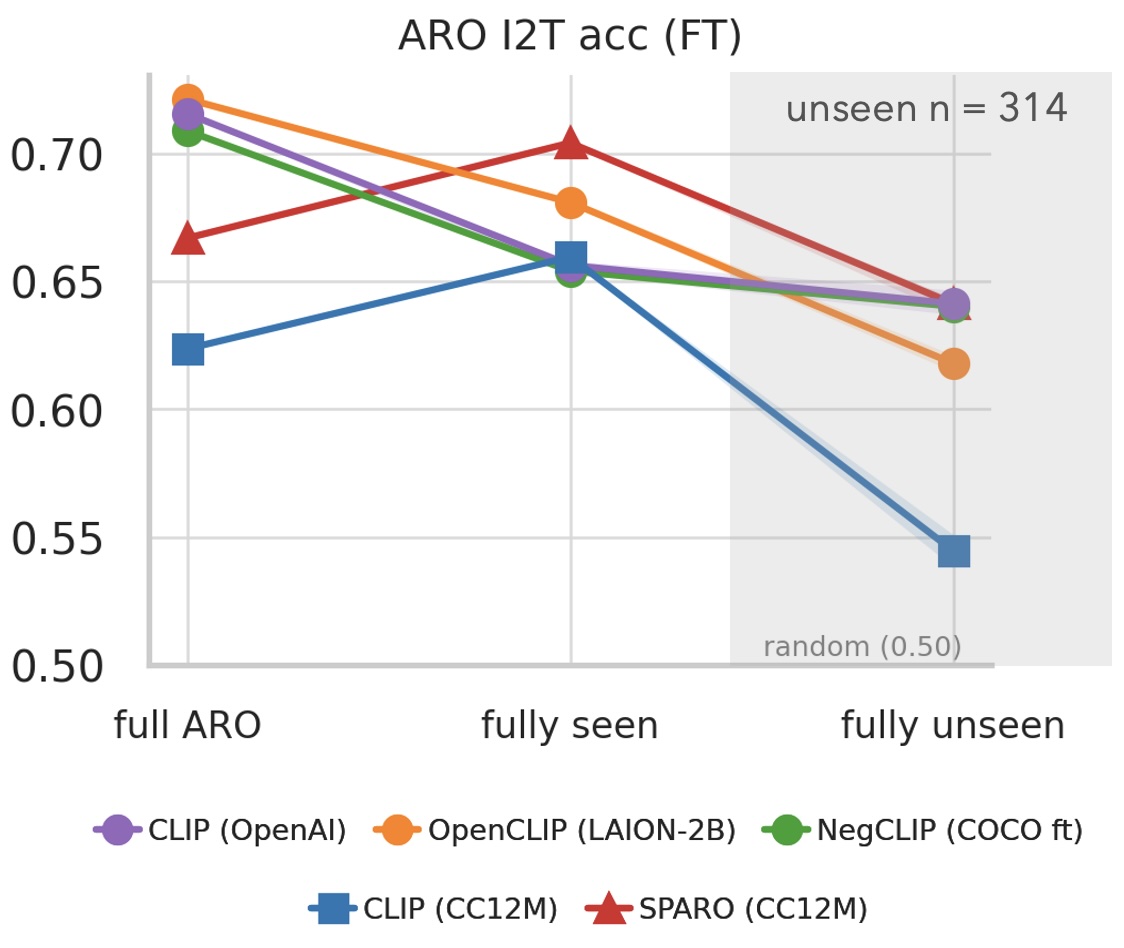
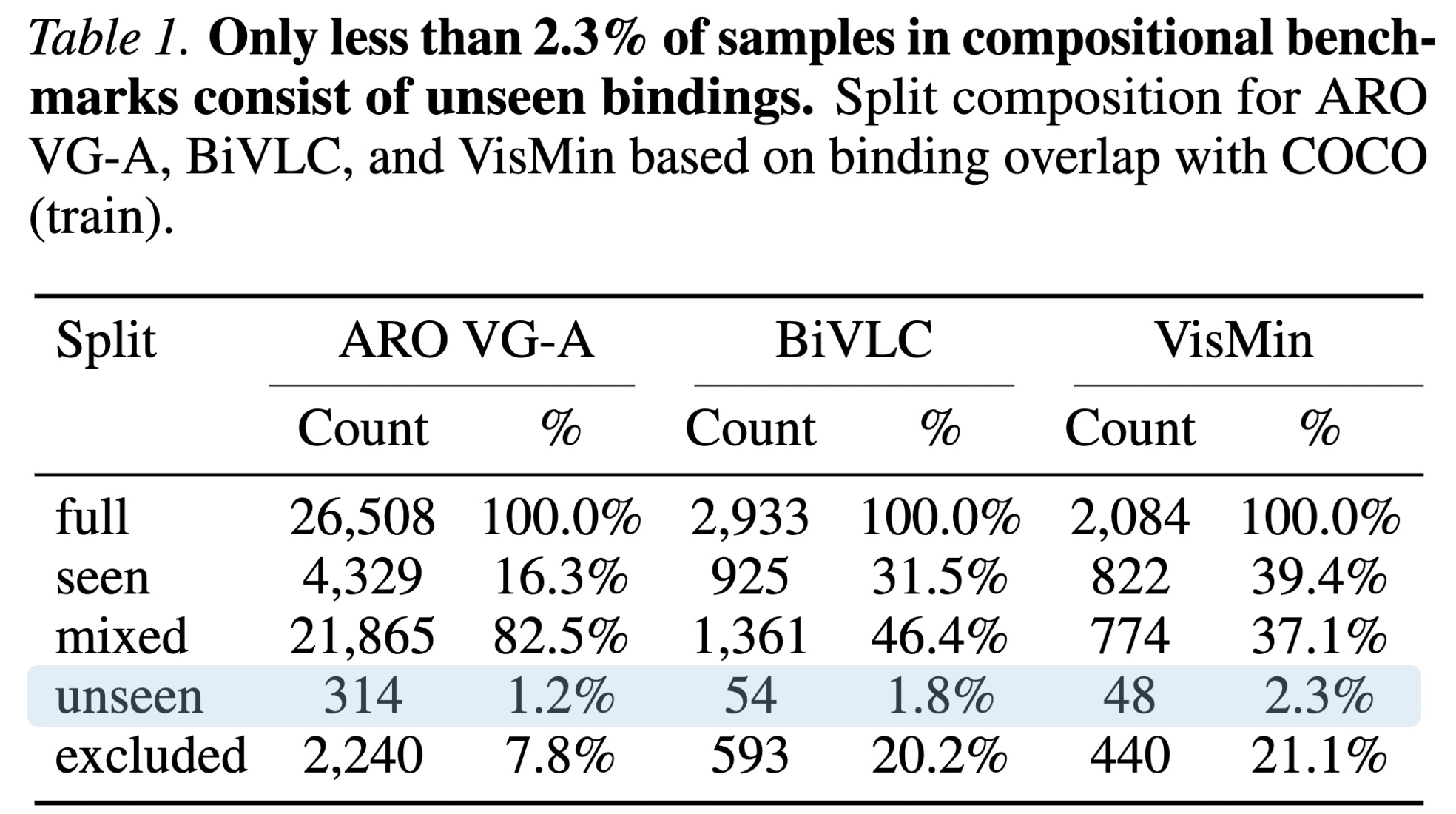
2The benchmarks barely test for generalization to unseen bindings
Across ARO VG-A, BiVLC, and VisMin, fewer than 2.5% of samples involve unseen
bindings.
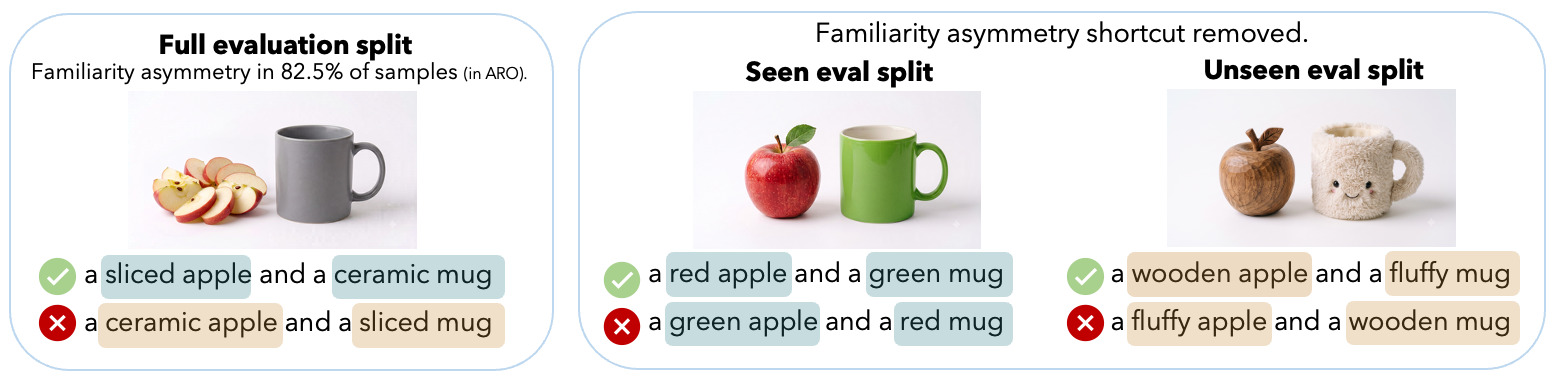
Bindings in correct captions are about twice as COCO-familiar as bindings in their corresponding negatives captions
(79.8% vs. 41.8% on ARO VG-A), so a model can score high by exploiting the
familiarity asymmetry rather than binding correctly.
Removing the shortcut reorders the leaderboard.
Recommendation
Report the splits, not the aggregate.
Use BindSplit and report model performance on the shortcut-free seen and unseen splits, not just the
aggregated benchmark score.
Otherwise reported improvements likely overstate how much CLIP has learned to bind.
Abstract
From the paper.
Compositional benchmarks track progress on CLIP-based compositional reasoning. Each new method
reports higher scores than the last, but it is unclear whether the improvements reflect generalization
to novel bindings or memorization of bindings already seen during training. To find out, we run two
analyses: a synthetic ground-truth study with curated fully-seen, partially-unseen, and fully-unseen
binding splits; and extension to three real compositional benchmarks (ARO VG-A, BiVLC, VisMin) using
binding-overlap with COCO as a proxy for the alignment-training distribution. On the synthetic
dataset, accuracy drops monotonically from fully-seen to fully-unseen across nine CLIP backbones.
On ARO VG-A, positive captions overlap COCO bindings nearly twice as often as their attribute-swapped
negatives (79.8% vs. 41.8%); only 1.2% of samples have no COCO-overlapping bindings. Restricting
evaluation to the shortcut-free seen split, where positive and negative captions are equally
COCO-familiar, reorders the top of the leaderboard relative to the full benchmark. The accuracy
drop from seen to unseen bindings broadly replicates on BiVLC and VisMin, though with greater noise.
Compositional benchmarks should report performance on these shortcut-free splits; otherwise reported
improvements likely overstate how much CLIP has learned to bind.
Cite
BibTeX
@inproceedings{
peng2026clip,
title={{CLIP} Models Generalize Less Than Compositional Benchmarks Suggest},
author={Shuman Peng and Arnas Uselis and Darina Koishigarina and Martin Ester and Seong Joon Oh},
booktitle={2nd Workshop on Compositional Learning: Safety, Interpretability, and Agents},
year={2026},
url={https://openreview.net/forum?id=C8MlQkr4bw}
}